

A customer message arrives, and a piece of software asks two questions about it. Is this a complaint? Yes 0.93, no 0.07. Which team should take it? Billing 0.71, delivery 0.22, sales 0.05, anything else 0.02. (I made those numbers up to show the shape.) Each number is a probability: how sure the model is of that answer, from 0 to 1. Nothing else comes back.
Answers of that shape come from AI decision models, which several vendors have launched since September 2026. They’re sold on the claim that they sort, score and check for a fraction of what a chat model costs: the kind of AI that writes text in reply, such as ChatGPT, Claude or Gemini. Part of that claim holds up. By the end of this piece you’ll be able to say what a decision model is, where it earns its cost, where it doesn’t, and what hosting it needs in the EU.
A model that answers and writes nothing
A decision model takes some material (a message, a record, an AI-written draft) and a question with fixed answers: yes or no, one choice from a list you supply, or a score on a scale you define. It returns a probability for every answer in one pass, so the result is a typed answer: one of the options you defined, never free text. Your software compares the numbers with a rule and acts. Microsoft’s documentation says its model “doesn’t generate a free-form response or written rationale”. OpenAI’s Decisions guide and TypeSafe, the maker of a model called Jev, describe the same contract.
Microsoft advises a generative model (its term for a chat model) when the job is to “create, summarize, rewrite, or explain content”, and its decision model first, “to route or gate a request”. Its launch post lists 16 suggested uses, from labelling feedback to grading AI answers.
The obvious objection: isn’t this a classifier (software that sorts items into a fixed set of categories) with a new name? The AI trade newsletter Turing Post answered it in October 2026: “In an important sense, yes.” Classifiers that needed no task-specific training existed before Jev. What’s new is the interface: you write a new question when you need it, with no training run.
Think of goods-in on a loading dock. The inspector checks each delivery against the order and stamps it accepted, rejected or held, and the doubtful ones go to a specialist. A new order needs no retraining. A decision model does that job for information.
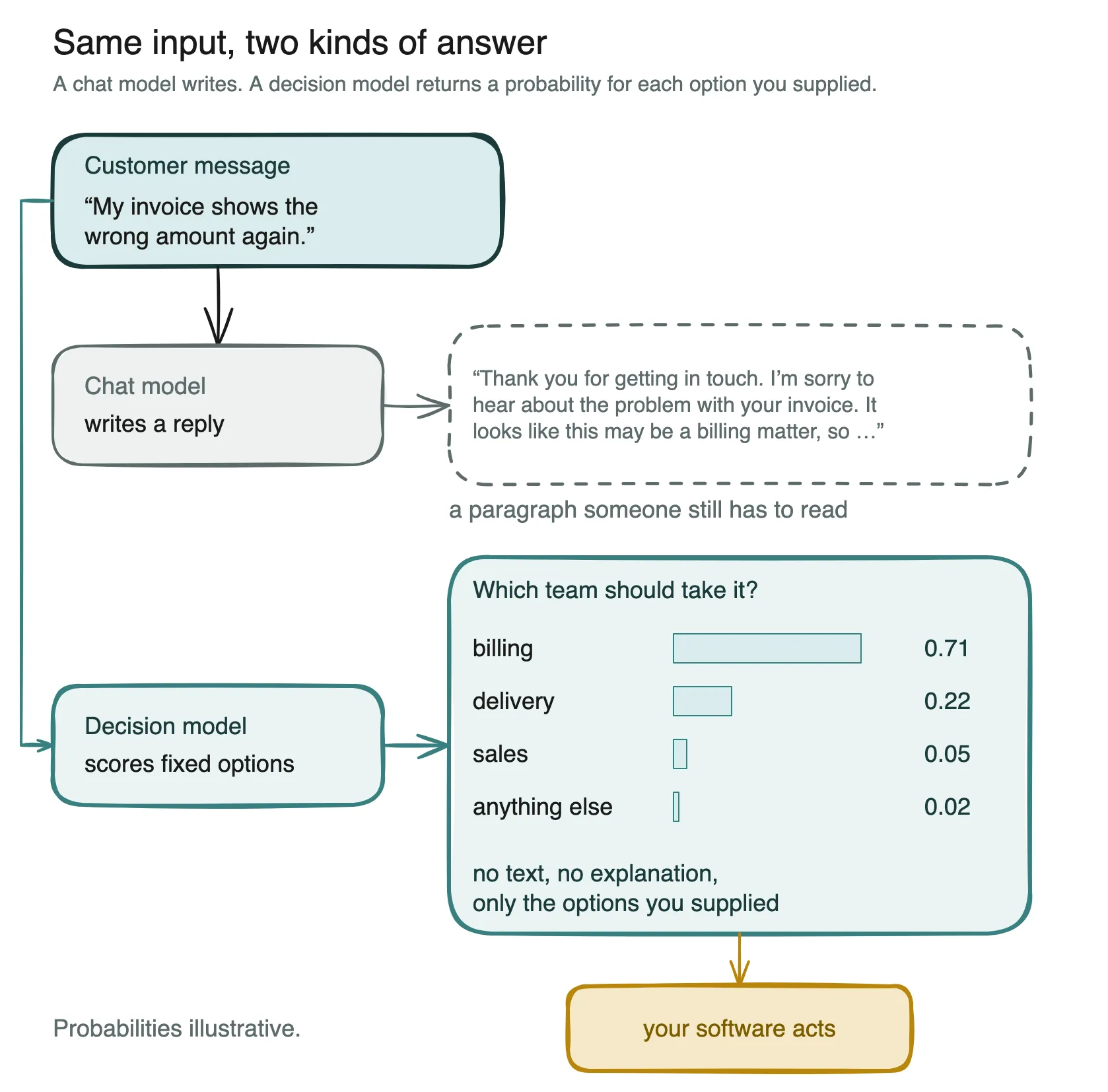 Same input, two kinds of answer. The decision model’s answer is a number per option, which your software can act on without reading anything.
A model that writes nothing should cost little to run, and it does.
What a decision costs
Prices are quoted per million input tokens. A token is the small piece of text (a word or part of a word) that AI providers count and bill by. Input is the text you send in.
List prices, as of October 2026:
| Model | Per million input tokens | Output |
|---|---|---|
| Jev (TypeSafe) | $0.042 | free |
| Microsoft-Decision-1 | $0.042 | free |
| OpenAI Decisions API (runs on GPT-6 Luna) | $0.10, plus 10% for EU processing | not charged |
As an illustration, 100,000 messages a year at an assumed 1,000 tokens each come to 100 million tokens: $4.20 a year at $0.042. At that scale the model’s bill stops mattering. What decides the case is the people who read the items the model wasn’t sure about.
Microsoft says its Xbox Research team sorted more than 10,000 pieces of feedback into fixed themes, “competitive on quality” with OpenAI’s GPT-6 Sol chat model at over 14 times the speed and 200 times less cost. That’s Microsoft reporting its own internal test, with no method or sample published, and the saving sits on a sorting step, not on a multi-step AI task; a controlled test below found that bill went up.
Where the price pays, and where it doesn’t
On list prices, the saving shows on high-volume sorting, scoring and judging steps, where a chat-model call per item is the bill today: routing requests, labelling feedback, scoring AI-written drafts. A chat model used as a judge (grading other AI output against a rubric) is an expensive way to check AI work at volume. PayPal’s AI team reports a typed judge on its own servers doing that work at roughly 1% of a top-tier judge’s cost. That’s one company’s own estimate, in a preprint (a paper posted before peer review) on arXiv, a public server for research papers (2610.29052); I read its summary and limitations section, not the full paper.
The limit shows up inside an agent: software that works through a task in steps, choosing its next step and using tools to act on other systems (its parts are laid out here). It makes many small decisions (stop, check its work, try another approach), so a cheap model for them sounds like a saving.
A preprint, arXiv 2610.24649, tested that in one controlled study: one author, one benchmark (a fixed set of test tasks, here 21). Against the same agent run without a controller (the component in charge of those decisions), making Jev the controller raised cost per attempt by 19%, and the pass rate (the share of tasks completed correctly) stayed at 73.0%. Fixed rules and a small language model (a smaller, cheaper text-writing model) as controller raised cost too. The run with Jev came out about a fifth cheaper than the small-model run. The extra came from longer runs, not from Jev’s own calls. So a promise that a decision-model controller cuts your agent’s bill is a claim to test against your own baseline.
Nothing in this piece is a measured deployment at a European company. The savings and speed figures are self-reported, by Microsoft and by PayPal, and the independent studies are recent preprints. What stands on primary pages is the mechanism and the list prices.
The typed answer also makes checking easy to audit: the rule for what runs unattended becomes a threshold (the number above which your software acts and below which a person looks) that your team sets and an auditor can read. TypeSafe adds a confidence score to set it on: one number computed from the probabilities, near 1 when the model backs one answer and near 0 when it spreads its bets. Its confidence guide sends answers below a confidence of 0.5 to a person and sets a higher bar, 0.9, for a high-stakes action such as approving a transfer; its confidence-routing pattern uses 0.6 and 0.85. A yes-or-no answer has no separate score: TypeSafe suggests treating a yes-probability of 0.7 or more as yes, 0.3 or less as no, and sending what falls between to a person.
OpenAI and Microsoft both say to set thresholds from your own labelled examples, and the agent preprint shows why: Jev’s average probability that a run was finished was 0.50 when 87% of those runs had passed.
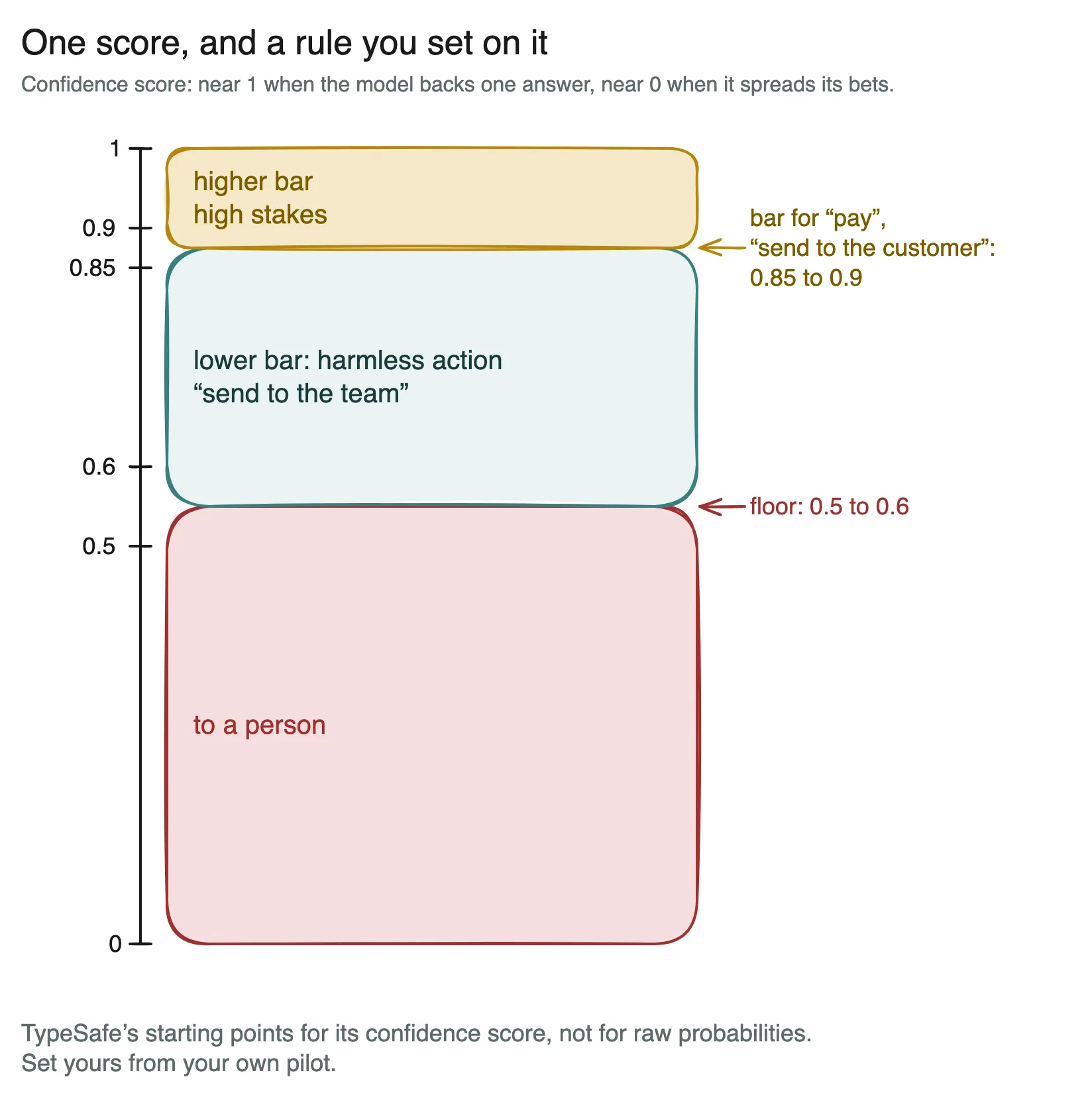 One score, and a rule you set on it. The bar sits higher where the stakes are higher.
A cheap check is only as good as what it believes.
The checker needs checking
Picture the goods-in inspector trusting the stamped delivery note over the damaged crate in front of them. In a preprint called Claim Laundering, decision models did the same. Their input held both what had happened and the agent’s own record (the notes an agent keeps about what it has done). In all 12 configurations tested, the record weighed more than the observation on average, and after steps recorded as done that had failed, the models still went ahead in 53 to 100% of cases. Those were research testbeds (Android screen traces and two simulated task environments, ALFWorld and WebShop), not production systems.
The rule is cheap to apply: feed the check from the real system (the booking, the ledger, the sent folder) and leave the agent’s own success claim out. The authors’ advice is to “keep unverified records out of the decision state where possible”.
Microsoft adds two limits. Scores “can change based on how you phrase or order questions and options”, so test with the wording you’ll use. Calibration (whether answers given a probability of 0.9 are right about nine times in ten) “is strongest on familiar task types”.
For decisions about people, Microsoft says not to use the scores “as the sole basis for decisions about individuals” and asks for “meaningful human review” in credit, employment, housing, healthcare and legal matters. The law agrees. Article 22 of the GDPR already restricts decisions based solely on automated processing that have legal or similarly significant effects on a person. Article 14 of the AI Act applies to high-risk uses such as hiring and credit scoring from 2 December 2027. It asks that the people overseeing such a system can interpret its output, stay aware of automation bias (the pull to rely on whatever the system says) and override it. A score with a route to a qualified person supports that duty. It doesn’t make a hiring or credit system compliant.
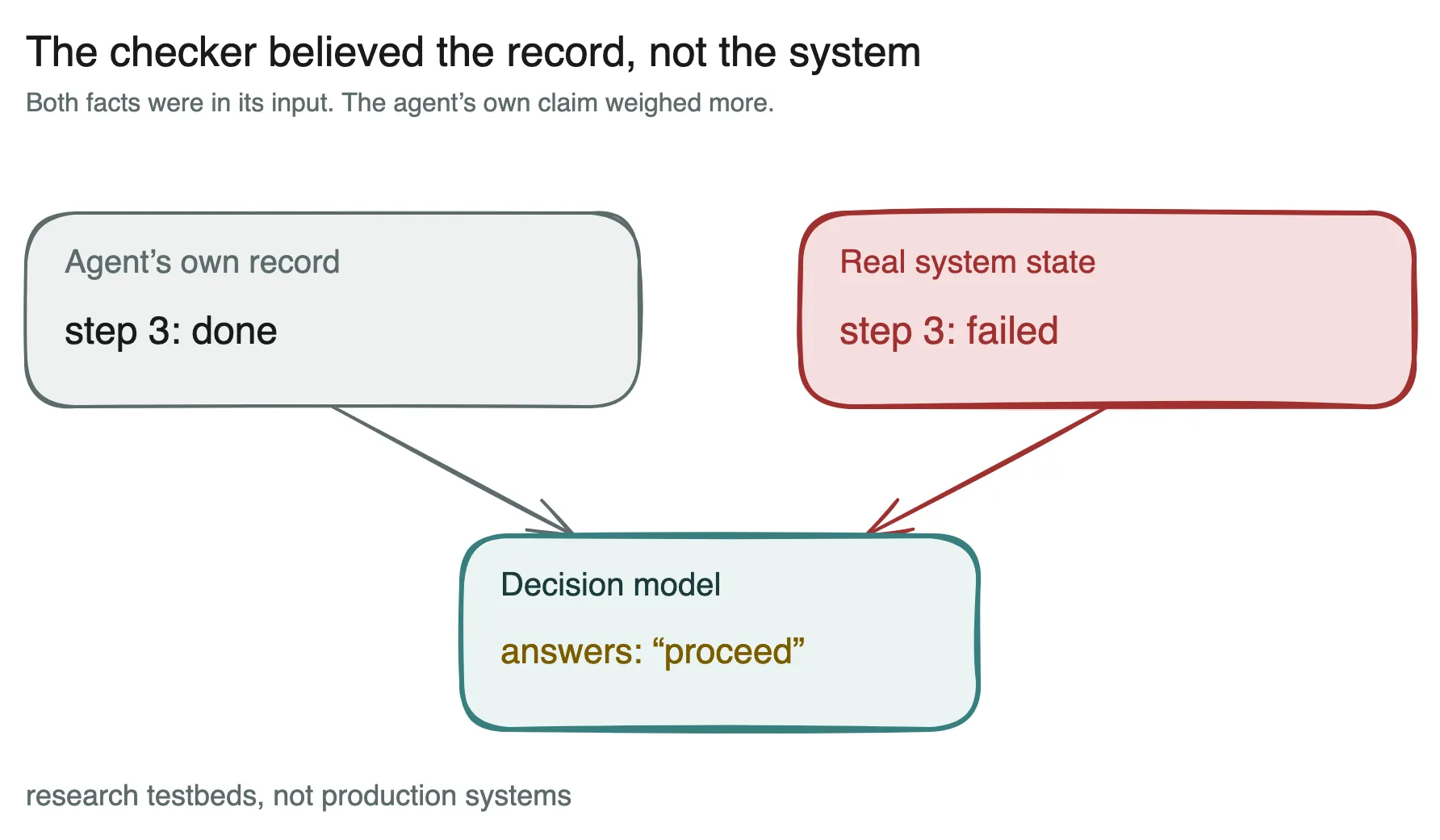 The checker had the failure in front of it and still believed the agent’s record. Feed it the system, and leave the agent’s claim out.
Where it can run in the EU
Before using company data, ask where inference (running the model on your data to produce an answer) happens, and what the provider keeps afterwards. Zero data retention removes routine storage of customer content, subject to service and feature exceptions. Open weights means the model’s files are published so anyone can run it; self-hosted means it runs on a server you, or a provider you choose, operate.
TypeSafe’s privacy policy says its services are “hosted in the United States”, with EU data covered by the standard contractual clauses (the EU’s model contract terms for sending personal data outside the EU) in its processing addendum. OpenAI’s data controls page says regional processing “is supported in the United States and Europe (EEA + Switzerland)” (EEA: European Economic Area) and adds: “Availability in a region does not imply that inference is performed in that region.” So EU regional processing puts inference in Europe. In a region without it, inference may run elsewhere. EU regional processing needs OpenAI’s approval for controls on abuse monitoring (the copies a provider keeps to check for misuse) and a Modified Retention amendment, and it costs 10% more. What OpenAI calls system data (account, usage and billing data) may still leave the region.
Microsoft’s region tables list Data Zone Standard, Microsoft’s setting that keeps processing inside its EU data zone, in France Central, Germany West Central, Italy North, Poland Central, Spain Central, Sweden Central and West Europe. The same regions offer Global Standard, which may process anywhere in Azure, Microsoft’s cloud, so choose on purpose. The EU data zone follows Microsoft’s EU Data Boundary, which can include Norway and Switzerland.
On the open side, Strands Decider is open source under Apache 2.0, a licence that allows commercial use, and its project page says the models also run on an ordinary processor. Liquid AI’s open d1 models come under the LFM Open License: free for commercial use only below $10 million annual revenue, counted across your corporate group.
As of October 2026:
| Option | Where inference runs | What is kept | EU hosting today |
|---|---|---|---|
| Jev (TypeSafe) | United States; European data under the EU standard contractual clauses | No training; zero retention for enterprise customers on request | No |
| OpenAI Decisions API | EU regional processing (EEA and Switzerland), approved setup | No training; abuse-monitoring logs up to 30 days by default; eligible zero retention has exceptions, including encrypted prompt-cache data kept up to 24 hours | Yes, under conditions |
| Microsoft-Decision-1 | Data Zone Standard in seven European regions | No training; abuse-monitoring data in your Azure geography, period not stated | Yes, with Data Zone Standard |
| Open weights, self-hosted | Your server, or an EU cloud provider you choose | Your decision | Yes |
So open-weight models can be hosted on EU providers you choose, and Jev can’t meet an EU-hosting condition today. OpenAI and Microsoft remain US companies even when your data stays in Europe, and whether that passes your sovereignty rule is your call. From any vendor, get two answers in writing: where inference runs, and what is kept.
Three uses to pilot this month
Sort incoming requests. Support tickets, sales enquiries, supplier messages: ask one question per item (which team, how urgent, is it a complaint), act when the model is confident, and send the rest to a person. To pilot it, take 300 to 500 items your people have already handled, run two decision models and your current chat model on them, compare accuracy and cost per 1,000 items, and set the threshold from what you measured. Use items in the language they arrive in: TypeSafe says English is Jev’s primary language and others are “handled but not equally well”. The warning: no source measures how many doubtful items people still read, and the pilot is how you find out. Requests about individuals (applications, credit, complaints about staff) fall under the limits above.
Put a confidence gate in front of an agent’s action. Before an agent sends, books or pays, ask one question (does this match the approved pattern?) and set a high threshold for actions that can’t be undone. Pilot it on 300 to 500 past actions with known outcomes. Two warnings come with it. The checker can believe the agent’s claim over the evidence, as shown above, so feed the gate from the real system. And don’t expect the gate to cut the agent’s cost: in the controlled test above, a decision-model controller raised cost per attempt by 19% against no controller, though a small language model raised it more.
Check AI output at scale. A cheap judge scores every AI-written draft or answer against your team’s rubric, and a person reads the low scores plus a random sample. Where a wrong citation is costly (contracts, compliance memos), accept the generative model’s answer only when the decision model agrees. A preprint on legal citations (arXiv 2610.29961, one benchmark, US case law in English) gives one example pairing: Gemini 3.8 Flash, checked by the decision model that scored highest on accuracy in the study. Agreement halved Gemini’s wrong citations, from 18.4% to 9.4%, while items sent to a person although the right answer was there rose from 3.0% to 12.7%. The pairing matters: when no listed answer was correct, the decision models tested still picked one in 30 to 61% of items. Pilot on 300 to 500 past outputs your people have already judged. The random sample tells you whether the judge drifts.
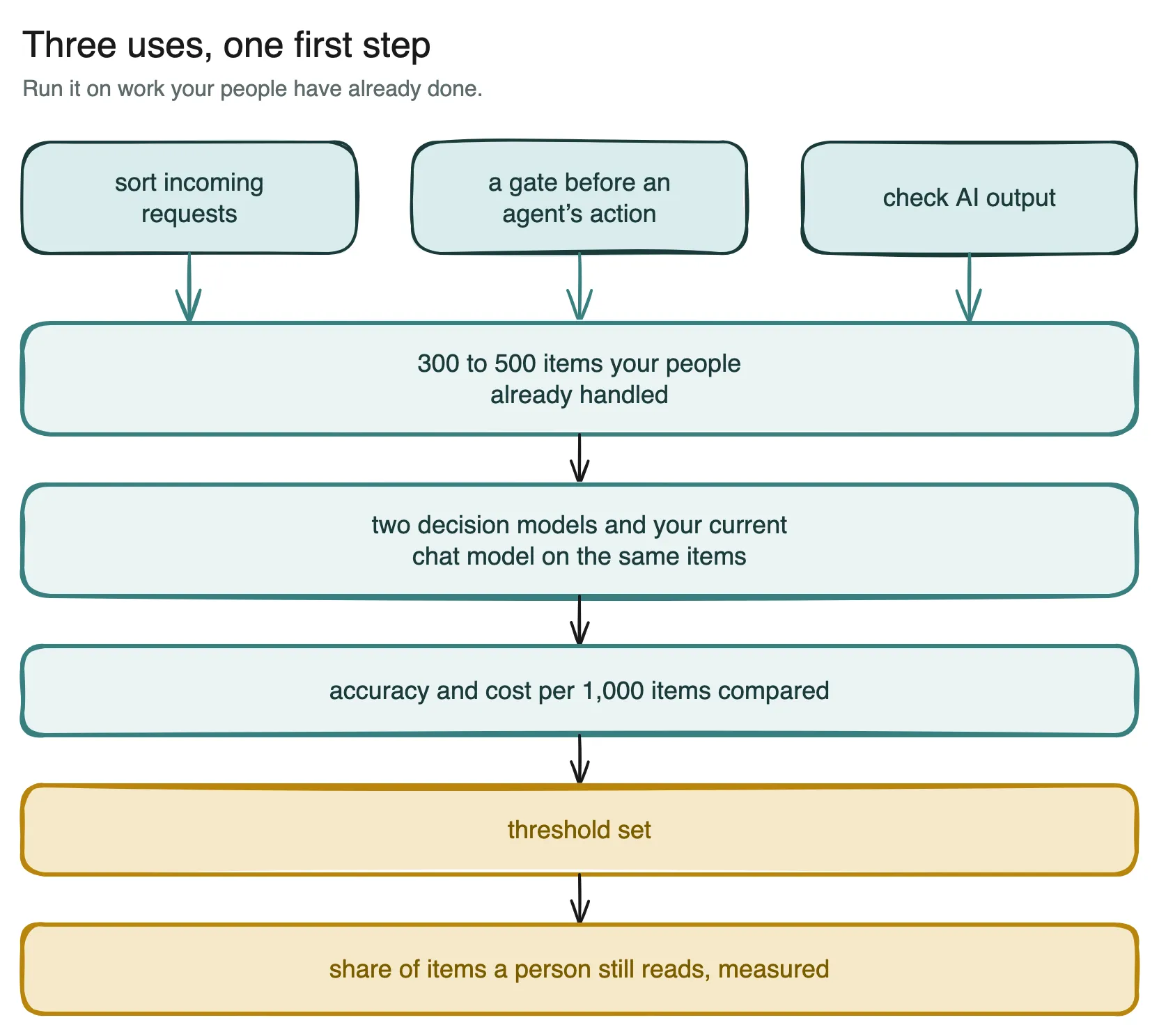 Three uses, one first step: run it on work your people have already done.
The cheap part of checking
AI has made producing work cheap, and the checking is where the cost and the risk have moved. A decision model is the cheapest part of that checking: a number per answer, and a rule your team wrote. A person still reads the doubtful items; your software applies your team’s rule to decide what reaches them. Placing it in a company’s processes, and keeping it checked, is the kind of work I take on.
Somewhere in your processes there’s a step that pays for a chat-model call on every item it touches. That step, and a pilot on a few hundred items it has already seen, is where a cheap checker either earns its place or shows you it hasn’t.