
On 12 January 2027 switching charges have to disappear from cloud contracts in the European Union, for the services covered by the switching rules of the EU Data Act, the regulation on access to data and on switching between cloud services. From that day the Data Act requires providers to charge nothing at all for switching, including the fees for moving your data out (egress). Two kinds of service are carved out by the Data Act itself (Article 31): a service whose main features were mostly custom-built for one customer and that is not offered broadly through the provider’s catalogue is exempt from the charge rule and from the functional-equivalence duty described below, and a time-limited, non-production version for testing and evaluation falls outside the switching chapter altogether. The provider of such a service has to tell you before you sign which obligations do not apply. If you signed this autumn’s renewal already, the date still applies to you, and so do the notice periods that decide whether a switch in the first quarter of 2027 is realistic. You do not have to switch to benefit from these rights. If you do switch, every party, you included, must cooperate in good faith (Article 27), and the contractual process still applies.
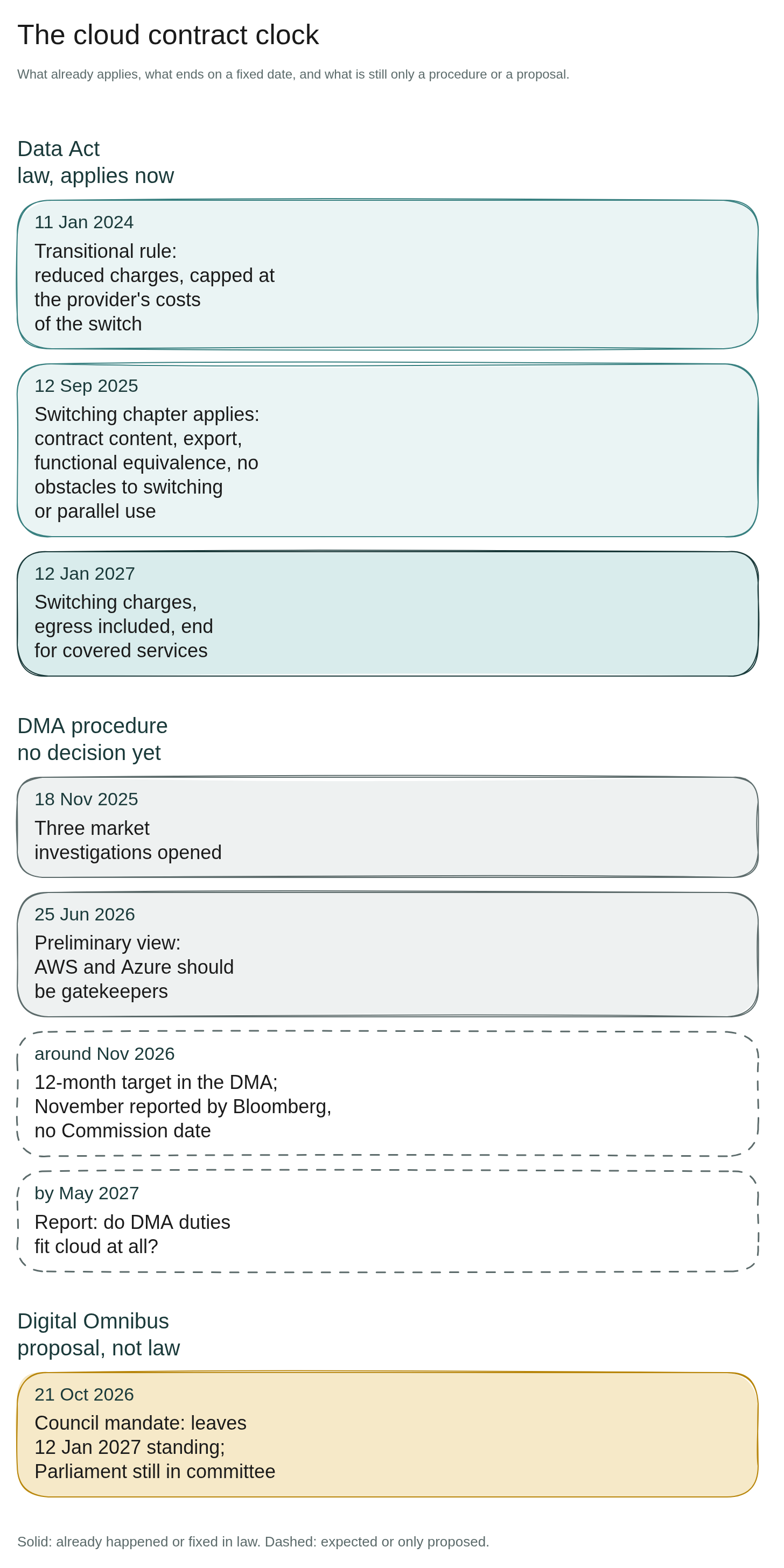 Only the top section is law, with fixed dates. The dashed dates are still to come, and the Digital Omnibus is a proposal, not yet law.
What has applied since September 2025
The Data Act is an EU regulation on access to and use of data, and one of its chapters governs switching between cloud and other data-processing services. It has applied since 12 September 2025. Four things in it matter to a buyer.
Cloud contracts must meet minimum requirements for their content, which gives you much greater transparency about what you have bought. Platform and software services (PaaS and SaaS, the layers where you rent a platform or an application rather than raw machines) must offer open interfaces free of charge. Every provider, infrastructure included, must export your data on request in a structured, commonly used and machine-readable format, under the conditions set out in the checklist below. Providers of pure infrastructure services (IaaS: rented servers, networks and the virtual resources needed to run them, without the operating services and software on top) must take all reasonable measures in their power to facilitate that, after you move to a service of the same type, you achieve “functional equivalence”: the same input should produce materially comparable results on the features both services share. And providers covered by these rules must remove obstacles to switching, or to using several providers at the same time.
That last clause is easy to read past. It covers running two clouds in parallel, not only leaving one, and it is the legal basis for asking why moving data between your providers costs what it costs.
“Egress is free now” is a half-truth
You may have been told that the big providers stopped charging for data leaving their clouds. Until 12 January 2027 that is true only in a narrow sense. Since 11 January 2024 a transitional regime has let providers charge for switching and egress, but no more than the costs they incur in direct connection with the switch, not their list price. On 12 January 2027, for the services the rules cover, even that ends for a switch.
What AWS, Microsoft Azure and Google Cloud offer in the meantime are exit programmes with procedures, and they differ more than the phrase “free egress” suggests. Each cell below comes from the provider’s own page, dated where the page carries a date and otherwise marked with the day it was read.
| AWS | Microsoft Azure | Google Cloud | |
|---|---|---|---|
| What the waiver covers | All data off AWS from all eligible accounts, or all data off one AWS service across them (AWS blog, update of 8 Oct 2026) | A full exit: credit for at most 60 calendar days of egress charges, and all Azure subscriptions must be cancelled; leaving single services is offered only to UK customers (Microsoft Learn, no date visible in page text, read 29 Oct 2026) | Whole services only; migrating part of a service is not allowed under the programme (Google exit programme, undated, read 29 Oct 2026) |
| Notice and timing | Request through AWS Support at least two months before the planned switch (EC2 FAQ, undated, read 29 Oct 2026); for an EU switch under the Data Act, a 30-day transitional period, extendable to at most seven months if the switch is technically unfeasible (AWS EU Data Act Addendum, file dated 10 Sep 2025) | Support request with your planned start date; 60 days from that date to move the data out, longer only if you include a migration timeline in the request (same Microsoft Learn page) | Exit Notice, a 14-day intake, a 30-day initiation period, a migration period of at least 30 days, then a Completion Notice and termination (same Google page) |
| What you must do afterwards | Delete the data or close the accounts; switching-related credits must be repaid if you do not comply (AWS EU Data Act Addendum) | Cancel all subscriptions associated with the account; the credit is applied at invoice level (same Microsoft Learn page) | Terminate the service; the credit comes on the final invoice (same Google page) |
| Excluded or reviewed | CloudFront, Direct Connect, Snow, Global Accelerator excluded (EC2 FAQ); additional scrutiny if the same account applies more than once (AWS blog) | ExpressRoute, ExpressRoute Direct, VPN, Front Door, CDN excluded (same Microsoft Learn page) | The exit-programme page names no exclusions; Google may review data movements and repeated requests (same Google page) |
| Running providers in parallel | The waiver covers moving off AWS, not running providers side by side (AWS blog) | Transfers at cost, not free, for customers in Europe using services of different providers in parallel, within one organisation and declared by support request (Microsoft Learn, no date visible in page text, read 29 Oct 2026) | For customers with an EEA billing address using covered Google DP Services, Google’s contractual EU Data Act Terms pass parallel-use egress on at cost at most (Service Terms, last modified 27 Oct 2026); its Data Transfer Essentials service is “initially offered at no charge” and may become billed after advance notice (Google documentation, undated, read 29 Oct 2026) |
AWS updated these terms on 30 September 2025 and again on 8 October 2026, so a summary written before this autumn is out of date. Its EU Data Act Addendum sets out the switching process and contains no clause on charges, whereas Google’s Service Terms state, contractually, that it will not impose any switching charges for a switch under its EU Data Act Terms. AWS and Microsoft both keep the right to change their programmes: AWS “may make changes with respect to free data transfers out to the internet at any time”, and Azure “might make changes regarding the egress credit policy in the future”.
The exit clause the Commission has already written
The most useful document in this story is not a law. Under the Data Act the European Commission has written Standard Contractual Clauses for cloud computing contracts: contract text you can insert into an agreement, developed to help especially smaller companies. There are six, described here following the Commission’s own descriptions:
- Switching & Exit: provisions on switching.
- Termination: provisions on ending the contract.
- Security & Business continuity: security and continuity during switching, including the provider notifying you of significant incidents.
- Non-Dispersion: a transparent contractual environment.
- Non-Amendment: no unjustified changes imposed unilaterally.
- Liability: a more balanced distribution of liability, including by avoiding unjustified limitations of the provider’s liability.
On 29 October 2026 the Commission adopted the clauses as Recommendation (EU) 2026/2394, published in the Official Journal on 6 November 2026 in every official EU language. The clauses are non-binding: their use is voluntary, and they can be amended. They also keep apart two costs that are easy to merge: for a switch after 12 January 2027 the provider “is not allowed to impose switching charges”, but if the switch completes before the agreed term of the contract ends, the clause on termination applies the contract’s early-termination fees. Use the clauses as a negotiation starting point with the Commission’s name on them, and ask the vendor to explain any departures.
The DMA, honestly
The headlines have been about the other law. The Digital Markets Act (DMA) is the EU’s rulebook for “gatekeepers”: very large platforms that the Commission designates and then subjects to a fixed list of obligations. On 25 June 2026 the Commission told Amazon and Microsoft of its preliminary view that AWS and Azure should be designated gatekeepers for cloud computing (press release IP/26/1444). It is real, and it is not a decision.
No designation had been adopted by 9 November 2026, and the Commission had stated no date for one as of that day. The DMA says the Commission “shall endeavour” to finish such an investigation within twelve months, which from the opening on 18 November 2025 points to around November 2026. That is a target, not a deadline, and the Commission already ran past the companion six-month target for its preliminary findings. A Bloomberg report of 2 October 2026, relayed by TNW, says the Commission plans to name AWS and Azure in November. Bloomberg’s own sources said the decision is still a draft and its timing could slip; TNW notes it has not confirmed the report independently and that the Commission has not publicly set a date. If a designation lands, Amazon and Microsoft would then have six months to comply.
The DMA’s obligations were written for app stores, search engines and operating systems. In my reading, a few would map well onto a cloud contract: no use of your non-public data to compete with you, no technical restrictions on switching, effective and continuous data portability, and no disproportionate conditions for ending a contract. Others, such as sideloading or app-store access terms, have no obvious cloud equivalent. On the same day it opened the two designation investigations, the Commission opened a third investigation into whether the DMA’s existing obligations work for cloud at all, with a report due by May 2027 at the latest. Anyone predicting specific remedies today is guessing.
For an AI-adopting leadership team, the most relevant passage in the Commission’s press release concerns the buyer. The Commission writes that the two providers’ “portfolio of Artificial Intelligence (AI) tools and partnerships have become a decisive factor in cloud procurement”, and that while AI is significantly increasing demand for cloud services, “AWS and Azure appear to retain a large proportion of this increased demand within their respective ecosystems”. That is the regulator describing, in its own words, the lock-in a leadership team may be building right now as it adds AI to its cloud estate.
What the vendors, the industry and the legislators say
AWS told The Register that “The EU already has comprehensive cloud regulation through the Data Act”, objecting to another layer of regulation under the DMA. Microsoft told the same outlet that it remains “concerned that ignoring the growing power of Google Cloud and Gemini will tilt the market in a harmful way”. CISPE, the association of European cloud providers (an interested party), welcomed the findings but called the omission of Google Cloud “a structural flaw”. The European Parliament, in a resolution adopted on 30 April 2026, called on the Commission, “in the light of the increasing strategic importance of cloud computing services”, “to closely assess whether providers of such services meet the criteria for their designation as gatekeepers under the DMA”.
The Digital Omnibus, the Commission’s November 2025 proposal to simplify several EU digital laws, would also touch cloud contracts if adopted, and its clause on early-termination penalties could reach the contract you sign next. On 21 October 2026 the member states’ ambassadors in the Council agreed their negotiating mandate. For some older contracts, concluded on or before 12 September 2025, for services other than raw infrastructure, that mandate would lift the switching chapter’s obligations except the one on charges: where the service was largely adapted to one customer, or where the provider is a small or medium-sized enterprise or a small mid-cap. This would be a second carve-out next to the existing one for custom-built services, and it would work the other way round: the existing one lifts the charge rule, the new one would keep it. The removal of switching charges stays, and contract terms contrary to it would be void. Early-termination penalties are not new: the Data Act already requires providers to disclose them before you sign (Article 29(4)). The mandate would explicitly allow proportionate ones in fixed-term contracts. None of this is law. The Council will negotiate only once the European Parliament has its own position, and the Parliament’s procedure was on 9 November 2026 still at the stage “Awaiting committee decision”. Even the Council’s version of the simplification package leaves 12 January 2027 standing.
What to do on Monday
Whether your renewal is coming up or already signed, each of these works at the next renewal or the next amendment.
- Put the Switching & Exit clause on the table. Download the Commission’s clauses, insert the Switching & Exit text into your draft and let the vendor explain what it will not accept.
- Ask in writing which charges the vendor treats as switching charges, and what happens to each one on 12 January 2027.
- Read any fixed-term draft for early-termination penalties. The end of switching charges does not cancel remaining commitments or termination penalties; the Data Act already requires advance disclosure of any early-termination penalties that might be imposed. Ask that those penalties be proportionate and capped. The Council’s mandate would explicitly allow proportionate penalties in fixed-term contracts; it is a proposal, not law, which is why it is worth settling in your contract now.
- Put the notice periods from the table into the plan. For a switch starting in March 2027, the request to AWS goes out in January at the latest.
- Ask which services the waiver excludes (the table lists them for AWS and Azure).
- If you run providers in parallel, get the terms in writing. Azure offers qualifying transfers at cost; Google caps parallel-use egress charges at the costs it incurs for customers with an EEA billing address using covered Google DP Services, while its Data Transfer Essentials service is initially free.
- If you rent infrastructure (IaaS), ask what functional equivalence means for your workloads. Name the two or three systems you would move and ask how the provider meets the requirement for each.
- For covered platform and software services (PaaS, SaaS), ask for free open interfaces.
- From any provider, infrastructure included, ask about exporting your data. When switching between services of the same type, if the relevant specifications or standards have not been published in the Union repository, you can request all exportable data in a structured, commonly used, machine-readable format.
- Read your provider’s Data Act addendum or terms. AWS has an addendum, Google has EU Data Act Terms in its Service Terms. Where you cannot find such a document, ask for one.
- Keep shorter terms or a break clause so the contract can still move once the DMA picture is clearer in 2027.
- Know where to complain. If a provider is actively obstructing a switch under the Data Act, the route is the authority your country has designated for the Data Act; in Germany that has been the Bundesnetzagentur since 30 May 2026. Potential DMA issues are a separate route: the Dutch competition authority, the ACM, which sits on the joint investigation team with the Commission, runs a tip-off channel for businesses (complaints in English are accepted, advice is given in Dutch only).
If your cloud estate is also where your AI runs, this list is part of a larger question about which workloads should stay where. I have written about keeping regulated data on a hyperscaler without giving up control. Working through that question for a specific company, contract in hand, is the kind of engagement I take on.
What not to do
- Do not price a DMA designation into a business case: it is preliminary, has no Commission date, and nobody knows which obligations will reach cloud.
- Do not accept “egress is already free” without asking under which regime: until 12 January 2027 a switch runs either on a waiver programme or the provider may charge for it at most the costs it incurs in direct connection with the switch; for parallel use, Azure charges eligible customers at cost, and Google caps its charges at the costs it incurs for covered services with an EEA billing address.
- Do not sign a term that runs well past January 2027 without the break clause above.