
Suppose I run a small company and give an AI the shared inbox. “Could you send me a quote?” goes to Sales. “I’ve been charged twice” goes to Billing. “I can’t log in” goes to Support. Three emails, three sensible decisions. I can already picture the hours I’ll save.
Then this lands on Monday morning.
Subject: Re: Renewal quote
Hi Jo, yes, we’d like to renew. Before I sign, could someone sort out the second charge on our last invoice? I asked about it on Thursday.
The AI sends it to Sales. I can see its reasoning. I can also see why the customer is about to ask a third time.
Jo in Sales has a renewal to close. Billing has a second charge to explain. The demo emails each fitted neatly into one department. This one gives two departments work to do and leaves one person, who has already asked once, waiting for a reply.
A year of sensible additions
The instructions had been growing for a year. Every line arrived for a good reason.
An email once went to the wrong team, so I added “Double-check the destination before assigning it.” Then the AI missed a request halfway down a long thread. Fair enough. “Be thorough. Read the entire conversation.”
A colleague wanted more consistent results, so the procedure got written out: summarise the thread, list the teams involved, explain the choice, assign the message. Then came the worked examples, pasted in. One sent a renewal to Sales. Another sent a disputed charge to Billing. Monday’s customer has had the poor manners to do both in the same sentence.
None of this was foolish. When I had to supervise each step, writing the steps down helped. A written specification still helps when Sales and Billing need to agree on who owns what. The trouble is that the lines stay long after the reason for them has gone.
Lance Martin, an engineer at Anthropic, lists the same habits in a talk about old prompts: “verification rituals, double check your work”, instructions to “be maximally thorough”, step-by-step procedures, piles of examples. They were written for earlier models, and his summary is that “prompts accumulate debt just like code.” That is prompt debt, and in his tests it was not free: “it actually increases cost and can reduce performance”.
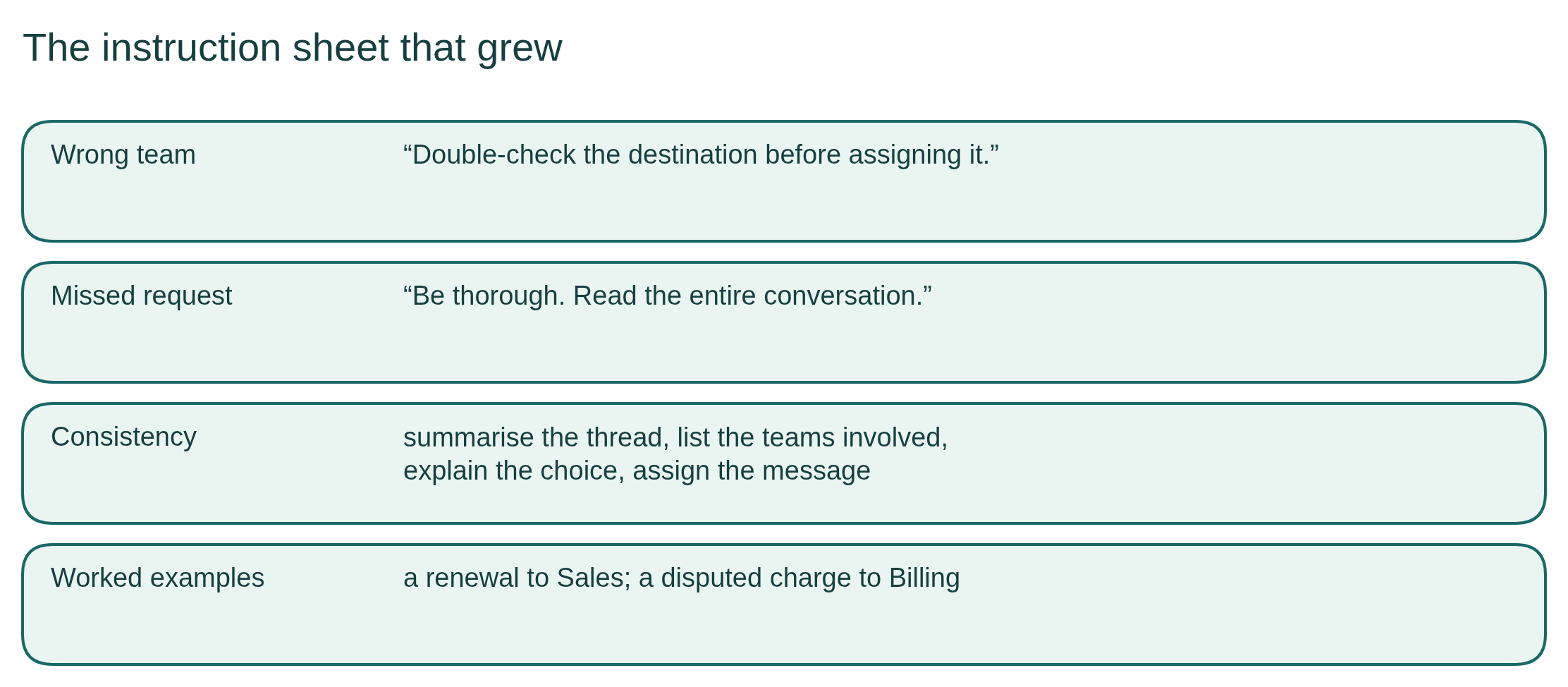 Every line answered a real problem, and each one made the instructions longer.
In the inbox, the cost is easy to see. The next person who asks for a copy of an invoice gets the full departmental analysis: a thread summary, a list of teams, a reasoned choice, an assignment. Meanwhile, on the genuinely difficult email, the AI has enough material to argue convincingly for either team. Who owes the customer a reply? The manual is silent on that point.
So the question changes. Which decisions can I now leave to the agent, and which can only the company make?
The one rule only you can write
In this illustrative company, I make one decision: Jo owns the reply about the renewal. Billing owns the investigation into the charge. Another company might choose differently. That choice has to be visible, because no amount of reasoning can discover a policy nobody has agreed on.
So the new brief goes on the page:
Give each customer enquiry one named person who owns the next reply. If another team needs to investigate, give it a linked task. Keep the enquiry open until the customer has been answered.
Then the agent gets context when it needs it. “I asked on Thursday” gives it a reason to look back through the thread. The account record tells it whether Jo still owns the renewal. How it investigates is its own choice. What the business supplies is the policy, access to the information and a way to tell whether triage is complete.
Lydia Hallie, who works on Anthropic’s coding agent, draws a similar line. Standing instructions, in her account, should carry what the model cannot find out for itself. Where several outcomes all “look pretty reasonable”, the person says “what done looks like” and makes it a check, because “prompting is not a guarantee that a model will do it.” By that test, the four-step procedure can retire. The ownership rule stays in writing.
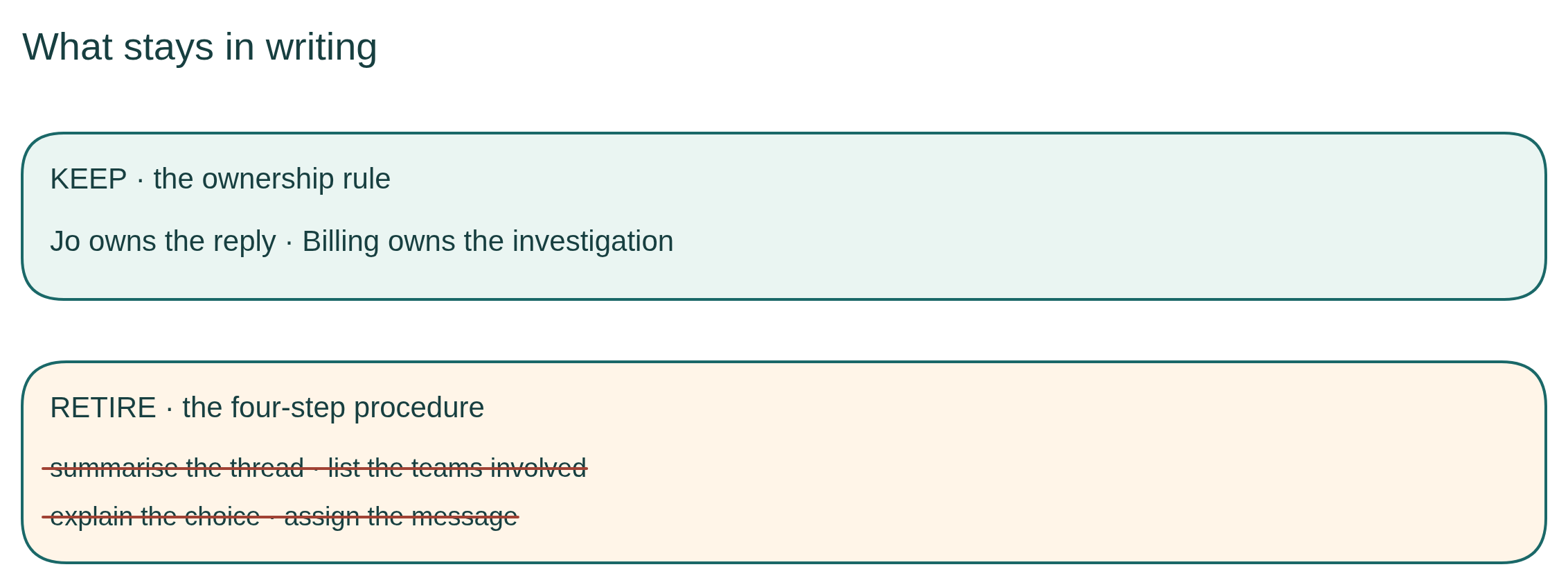 The business decision stays in writing; the four-step procedure can retire.
Monday, take two
Replay Monday’s email. The agent finds Jo in the account record, copies her on the case and creates a Billing task. Then it opens the case to check its work.
Billing task: assigned. Reply owner: blank.
Pause there. Anyone who has ever been copied on an email knows exactly what went wrong. Being copied told Jo about the case; it did not make her the one who answers. The agent puts Jo in the owner field, opens the case again and confirms that both assignments are present.
Triage is finished. The customer is still waiting. Keep the enquiry open. That is an honest end to the agent’s job, and a precise picture of a loop: it tried something, saw what happened, corrected a mistake and checked again.
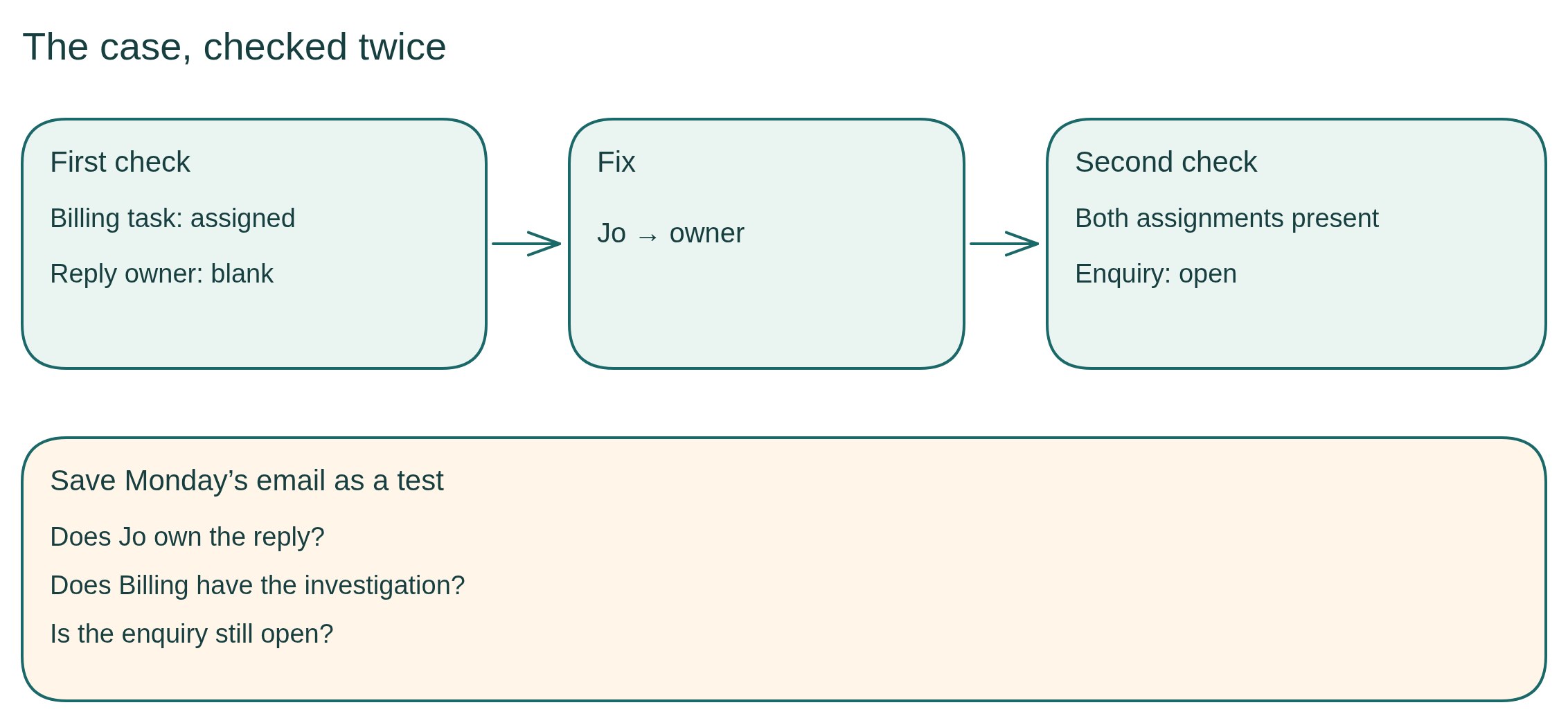 The agent adds the missing reply owner; Monday’s email then becomes a test.
One last step. Save Monday’s email as a test. Next time somebody edits the instructions or switches models, run it again. Does Jo own the reply? Does Billing have the investigation? Is the enquiry still open? Martin describes teams doing the same with real failures, “putting those in regression tests once they all pass”. It gives an old mistake a better home than another permanent paragraph in the prompt.
Which email from last week would you put in your next demo?