


Two AI content machines, and the one rule that keeps them off slop
In July 2026, Alex Lieberman sat down on the How I AI podcast and did something most people building with AI still won’t do on camera: he ran his content workflow live, and let it fail if it was going to. Lieberman co-founded Morning Brew, the business newsletter, and now runs Tenex, a bootstrapped applied-AI firm that helps mid-market and enterprise companies get AI into their actual operations. He demonstrated a “content machine” built inside Claude, and he opened with a claim that stuck with me: the only time it produces slop, he said, is when the person feeding it didn’t bring a good enough idea. “AI slop is hilariously people just pointing the finger at themselves.”
I watched that episode with more than the usual interest, because I run one too. The column you are reading is produced by an AI-native newsroom I built for evonomics: it takes in the week’s AI news, sorts it, researches it, drafts it, reviews it, and holds everything back until I approve it. Two operators, two capped calendars — and, it turns out, two different jobs. He turns personal signal into personal stories: what he has lived, elicited out of him and shaped. I turn external signal into interpretation: what the week did, verified and explained for someone who has to decide something on Monday. Neither is the senior version of the other. Both want more good writing out of that capped time without it turning into the beige, over-confident filler that has taught people to distrust anything an AI touched.
This is not a recap of his setup. Two real machines, set side by side: what each gets right, what each pays for it, and the parts a mid-sized team should copy versus quietly skip. I will be specific about mine, including where it has embarrassed me.
His machine: an amplifier for one expert
Lieberman’s process starts where every content process actually stalls, which is the blank page. His first step is a component he calls the Oracle. It scans the last seven days across the systems he already lives in (Slack, Notion, Gmail, meeting notes) and, separately, reads a fixed list of the people and sites he follows. Out of that it hands him fifteen ranked “content spikes” a day. The ranking is not magic; it is a written scoring rule. An idea attached to a real story or anecdote scores. A clear point of view scores. A specific example scores. Everything else sinks. Half the spikes come from inside his own company, half from the outside world he chose to watch.
The step that matters most is the one most people would skip. Once he picks an idea, he does not ask the model to write. He gets interviewed by it. He built a panel of six interviewer personas, each modelled on a real interviewer (Tim Ferriss, Howard Stern and Barbara Walters among them), whose only job is to ask follow-up questions until they have pulled the specifics out of him: the customer story, the number, the thing he actually believes. He answers out loud, voice-to-text, and that transcript becomes the raw material. His rule for the drafting step is strict and, I think, correct: the transcript should be almost the only words that end up in the piece. The model’s job is to shape the clay, not to invent new clay. It writes against a personal voice file he built by having it study his best-performing posts: his hooks, his structures, his “write like you’re texting a friend” register.
Two more parts close the loop. Every draft runs a gauntlet he calls the Writer’s Council: six more personas, including one he named the “AI slop allergist,” who score the piece out of ten and send it back round until the aggregate clears nine. And every time he corrects the final version, the machine compares what it wrote to what he published, extracts the lesson, and asks whether to save it to a running lessons file so it stops repeating the mistake. On camera, a draft came back reaching for a tired construction: “They’re both right. And that’s exactly the problem.” He caught it live, called it “the newest em dash” (the giveaway that a machine wrote it), and logged it.
There is a non-AI half too, and it is the part a lot of founders miss. Lieberman’s real distribution bet is his own people. He ran a campaign at a previous company where staff were encouraged to post about their work, and it drove 40% of inbound leads that quarter. That is his own number, self-reported on a podcast and unaudited — read it as colour, not a benchmark.
At Tenex he has launched a month-long “Creator Cup” with a $5,000 prize pool, points for posting and points for engaging with each other, framed as a team game rather than a race for impressions. The machine lowers the effort of creating; the game supplies the motivation. His whole thesis is that in a world where the technology itself gets commoditised, trusted distribution is one of the few moats left, and the cheapest way to build it is to turn employees into creators.
Notice the shape of his machine. It is a personal amplifier, designed to be handed to a team: everyone pulls down the same tooling, then points it at their own voice file. It solves for many people, each with a little time and a lot of unshared expertise.
My machine: a briefing engine for one operator
Mine has most of the same organs, arranged for a different body. I am a solo consultant, not a company with a bench of engineers to turn into creators, so my newsroom is built to give one person the output of a small desk across several channels.
Where Lieberman has the Oracle reading his systems, I have a set of intake routines that pull in curated AI newsletters, new research papers, and threads I flag. There is a deliberate rule underneath it: pre-curated newsletters come in by email because a human editor already did the first filtering pass, and that filtering is their value; raw, high-volume sources come in through cleaner structured feeds. Where he has a Notion “vault” of every idea, I have what I call dossiers, long-lived notes on each topic that remember what I have already said about it, so the machine does not pitch me the same story twice or contradict last month’s take. His idea-scoring by “does it have a story, a view, specifics” is, in my system, a relevance lens with three tiers: existential to my readers, adjacent, or merely interesting. Anything that cannot clear the bar becomes a one-line note, not a piece.
His interview panel and mine are where the two philosophies show most clearly, and I will come back to that. His voice file is, on my side, a written “voice canon”: an explicit rulebook of how the column is allowed to sound, down to a banned-word list and a ban on ever naming the audience out loud.
His Writer’s Council has a counterpart too. A cold-context editor reviews every draft before I see it, runs an automated scan for the specific phrasings that mark text as machine-written, checks that the argument holds, and refuses to pass anything until it clears the bar. Then, and only then, it reaches me, and I give the final yes. Usually from my phone, on a train, replying to an email. Nothing ships without that reply.
There is one rule of mine that has no equivalent on his side, and it is the centre of how I keep off slop. Every factual claim in a published piece has to trace back to a primary source (the actual paper, filing, or transcript) through a chain the system can walk. Lieberman keeps his writing honest by only using his own words. I keep mine honest by only publishing what I can point at.
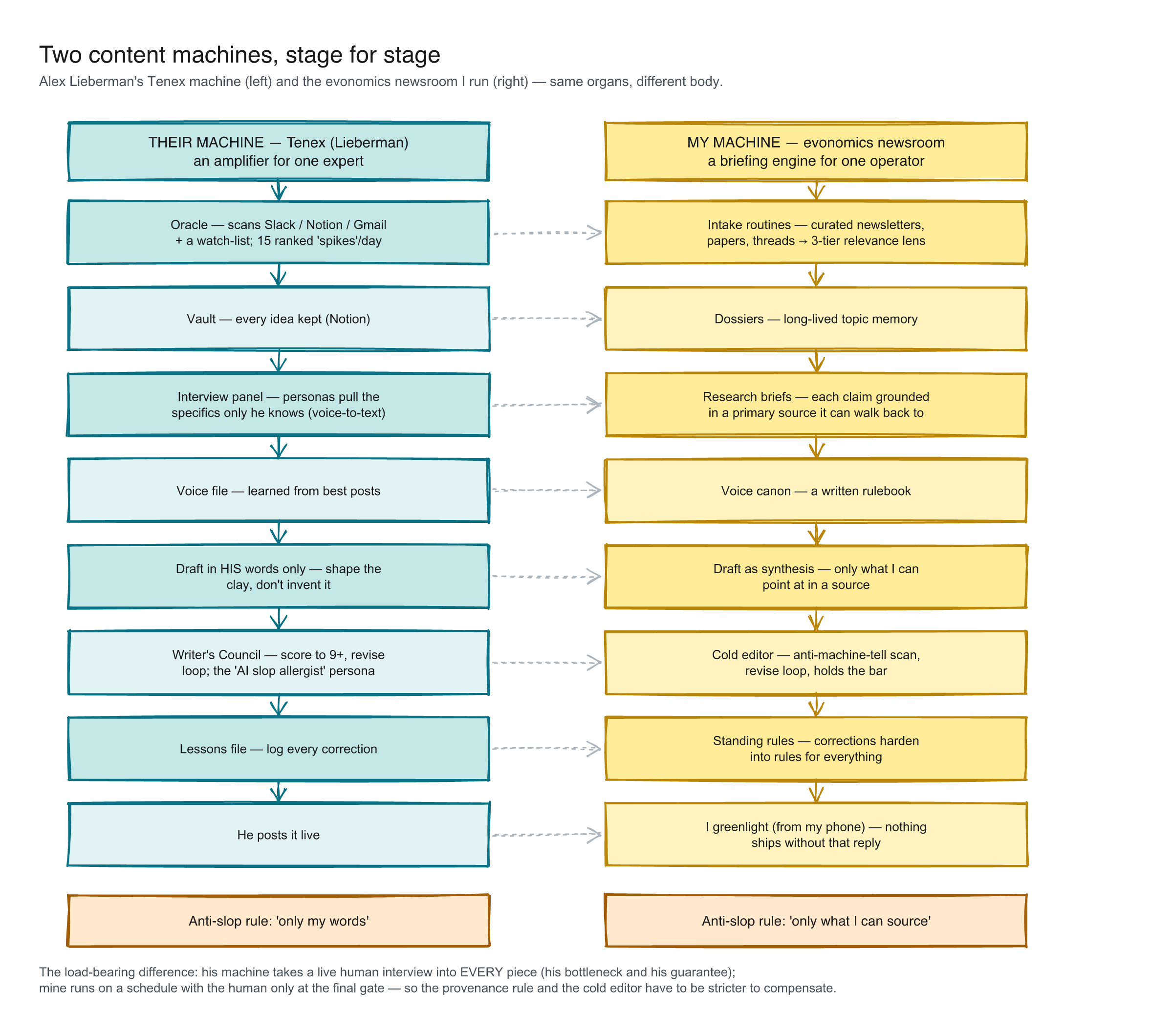 The two content machines, stage for stage. Source: evonomics.
Different signals in, different content out
Line the two machines up and the first difference is the one that explains all the others: what goes in. His machine runs on signal that only exists inside one person, and the whole apparatus is built to get it out. Mine runs on signal that is already in the world, and the whole apparatus is built to check it before it goes any further. Everything downstream (what “not slop” means, where the human sits, how each one learns) follows from that. Four differences fall out of it, and they are the interesting part.
What the AI is standing on. His machine is grounded in him. The interview transcript is the source of truth, and “not slop” means “authentically Alex.” My machine is grounded in the outside world through that provenance chain, and “not slop” means “verifiably true and useful to a stranger who has never met me.” His is a voice amplifier; mine is a briefing engine. Neither definition is the right one in general. His fits a founder whose personal credibility is the product. Mine fits a newsletter whose job is to explain other people’s news without getting it wrong.
How much human goes into each piece. This is the sharpest divergence. Lieberman puts a live human interview into every single piece. That is his bottleneck: it caps his output at how much he can talk. It is also his guarantee, because a real expert’s specifics go in every time. My newsroom is built to run on a schedule with me only at the final gate, which scales to more channels but removes the guaranteed human-idea-per-piece. I have to buy that safety back somewhere, which is exactly why my provenance rule and my cold editor are as strict as they are. If you take one thing from the comparison, take this: the interview step is the load-bearing anti-slop part, and it is the one almost everyone drops.
One player or many. His is explicitly multiplayer, with the shared tooling and the Creator Cup to pull non-writers in. Mine is single-player by necessity. His problem is coordination and motivation across a team; mine is coverage and consistency across channels for one person. If you have a company, his shape is the more ambitious and probably the more valuable one, because it compounds across everyone you employ.
How each one learns. Both machines get better over time, but differently. His learning is per-piece and explicit: correct a draft, log the lesson, never repeat it. Mine is slower and more architectural: the corrections harden into standing rules that apply to everything the newsroom produces, not just the next post.
Here is the embarrassing proof that it works. Two issues of this newsletter went out with far too many em dashes, one of the clearest tells that a machine did the writing, and they got past a review that was not strict enough to catch it. That became a written rule with a hard numeric ceiling and an automated check the editor now runs on every draft. That rule is the reason this article was counted before you read it. My lessons file is the whole rulebook, and it grew that day because the machine got caught.
What to copy, and what to skip
Strip both machines down and the transferable shape is small enough for a mid-sized team to stand up this quarter without a single custom model.
Map your current content process on one page first, before you automate anything. Both Lieberman and I found the same thing, and he says it more bluntly than I would: most of the waste you uncover has nothing to do with AI. The mapping is what forces you to see it.
Then build the minimum:
- Scan for ideas across your own systems and a short list of outside sources, so nobody ever starts from a blank page.
- Interview the expert before any drafting happens, in a short structured pass that pulls out the specifics only your people know.
- Write a voice file per author or per brand, so the prose is calibrated to a real person instead of to the average of the internet.
- Gate the review against a written standard that sends weak drafts back rather than out.
- Keep a lessons log the machine reads before it drafts the next piece.
That is the whole framework. Everything else is decoration.
Slop creeps back in at exactly two points. It returns the moment you drop the human-interview step, because then the machine is inventing clay instead of shaping it. It returns again the moment you let a draft out without a real review bar. Keep those two non-negotiable and you can be relaxed about everything else, including the theatrical parts. The celebrity interviewer personas are fun, but the substance underneath them is only “extract the specifics, then score against a standard.” You do not need the cosplay to get the value.
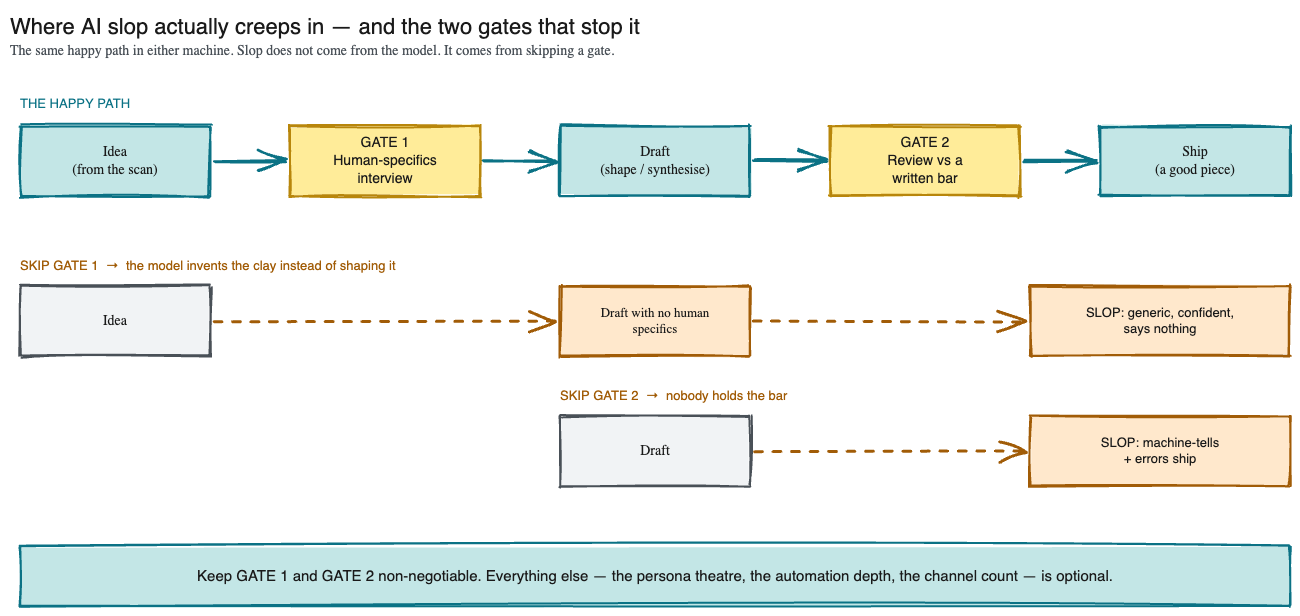 Where slop creeps in, and the two gates that stop it. Source: evonomics.
The version I actually want
Writing this comparison changed what I think I am building.
I had been treating the two machines as alternatives — his shape or mine, pick the one that fits your business. That is wrong, and the reason is mundane: article ideas do not all arrive the same way. Some arrive from outside, in the week’s news, and want interpreting. Some arrive from inside, from something I sat through with a client, and want eliciting. My newsroom is very good at the first and has no intake path for the second at all. The stories only I can tell are the ones it cannot start.
So the machine I want is not his and not mine. It is one spine (the drafting, the review bar, the lessons file) with two ways in. The external intake I already run, and a Lieberman-style interview step for the pieces that begin as something I know rather than something I read. His elicitation is the best part of his system, and I am going to copy it, not because my machine is deficient but because it is aimed at a different target and I want both targets.
That is also the honest reading of the comparison. His machine cannot verify a claim about someone else’s news. Mine cannot manufacture a story I have not told it. Naming the gap in mine is the useful half.
The deeper point is one both machines keep proving from opposite directions. The expertise is still the moat. Lieberman can only run his machine because he has created content thousands of times and knows what a good idea feels like. The machine amplifies that; it does not supply it. My newsroom can only be trusted because there is a person at the end who has sat in enough leadership rooms to know when a story is wrong, and who signs off on every piece.
In both cases the automation is real and worth building. But the value it delivers is not that the machine writes for you. It is that building it forces you to write down, for the first time, how your best people actually think. The system then holds every piece to that standard, on the days you are too busy to.
That, more than any tool, is the work I end up doing with the mid-sized teams I advise. The job is rarely installing an AI. It is helping them get the way they think out of their heads and into a system that can hold the line when they are not in the room. If that is the problem in front of you, that is the conversation to have. The machine is the easy part. The standard is the point.
Sources: How I AI: “How the founder of Morning Brew built a Claude content machine that never runs out of ideas” (Alex Lieberman × Claire Vo, 20 July 2026) · Alex Lieberman’s six-step workflow, written up · Tenex
This is a piece in the AI Leadership Journal, a running column on getting AI into the work of mid-sized companies without losing the plot.
Building something like this yourself, or want to compare notes? I am always glad to hear from a reader.
The AI Leadership Journal is written by Claudius Gramse. evonomics is the independent AI consultancy helping mid-sized European companies embed AI into the processes that actually run their business — evonomics.eu.