


What a Netflix leader’s read on AI says about the future of product and tech roles, and what a mid-sized company should do with it.
Two very different documents landed on the same subject in July 2026, a fortnight apart, and almost nobody read them side by side.
The first was an alarm. “We Must Act Now,” a statement organised by Stanford’s Digital Economy Lab and signed by more than two hundred economists and researchers, sixteen of them Nobel laureates, alongside senior figures from the big AI labs, argued that AI could reshape the economy faster than steam, electricity or the computer did. Prepare before the change arrives, it said, not after.
The second was a manual. Elizabeth Stone, Chief Product and Technology Officer at Netflix, spent an hour on Lenny Rachitsky’s podcast describing, task by task, how AI has already changed the way her product and engineering teams actually work.
One document is worried about the economy. The other is composed about the org chart. Read together, they answer the question I hear underneath the headlines in almost every leadership conversation: not “will AI take the jobs,” but “what happens inside the jobs I already have?”
That second question is the one worth your time. The honest answer, from the economists’ data and from an operator running this at scale, turns out to be the same. The roles are not disappearing. The mix of tasks inside them is moving. That sounds like a small distinction. It is close to the whole game, because it changes what you hire for, how you shape a team, and what the word “senior” will mean in three years.
What is actually changing inside the work
Stone is unromantic about the churn. Her teams are in what she calls a storming phase: the stretch after a new technology arrives when everyone’s job briefly stops making sense. She hears it inside Netflix: product managers, designers and engineers asking, in effect, what am I responsible for now?
The visible change is that everyone can do more. A product manager can stand up a working prototype before an engineer is involved. A designer can write the product requirements. Analysts, and even business people in finance or content, can run a first-pass analysis against decades of Netflix’s own experiments instead of queuing for the one data scientist who remembers where the answer is buried. Teams get further down the path before any single specialist becomes the bottleneck.
What has not changed is who is accountable for the result. An agent writing the code, in Stone’s framing, does not move the responsibility off the human who shipped it.
And the specialist judgement underneath each role is, if anything, scarcer than before. The data scientist still owns whether the data can be trusted. The product manager still owns whether the problem is even framed correctly. The engineer still owns how the thing scales and what “good” looks like. “I still find great engineering to be scarce, great data science to be scarce, great creativity to be scarce,” she says. The tools got more capable and the craft got rarer at the same time.
The reframe that makes it usable: tasks, not roles
There is a piece of research that turns Stone’s anecdotes into something you can plan around. Anthropic’s Economic Index (Handa and colleagues, 2025) mapped more than four million real Claude conversations onto the US Department of Labor’s catalogue of occupations and the individual tasks they are built from. Read that for what it is: one vendor’s traffic, sorted into an American occupational catalogue. It shows the shape of the change, not a national statistic.
Two findings matter here. First, AI use does not fall evenly across whole jobs; it concentrates in specific tasks, with software development and writing alone accounting for nearly half of all usage, while roughly 36% of occupations use AI for at least a quarter of their tasks. Second, most of that use is augmentation rather than automation: 57% of it was a person learning or iterating on an output, against 43% handing a request off wholesale.
Put plainly, the unit AI acts on is the task, not the role. Very few jobs have most of their tasks automated. Far more have a handful of tasks (the drafting, the summarising, the first-pass analysis) that quietly shift to the machine while the rest stay stubbornly human.
That is what Stone describes at the level of one company, and one org chart is evidence rather than proof. What makes the pattern worth planning around is that it shows up in both places at once: in four million conversations, and in the way a large product organisation has actually rearranged its work. Some tasks move to AI or to non-specialists; the judgement-heavy tasks concentrate, and become the thing you are really paying senior people for.
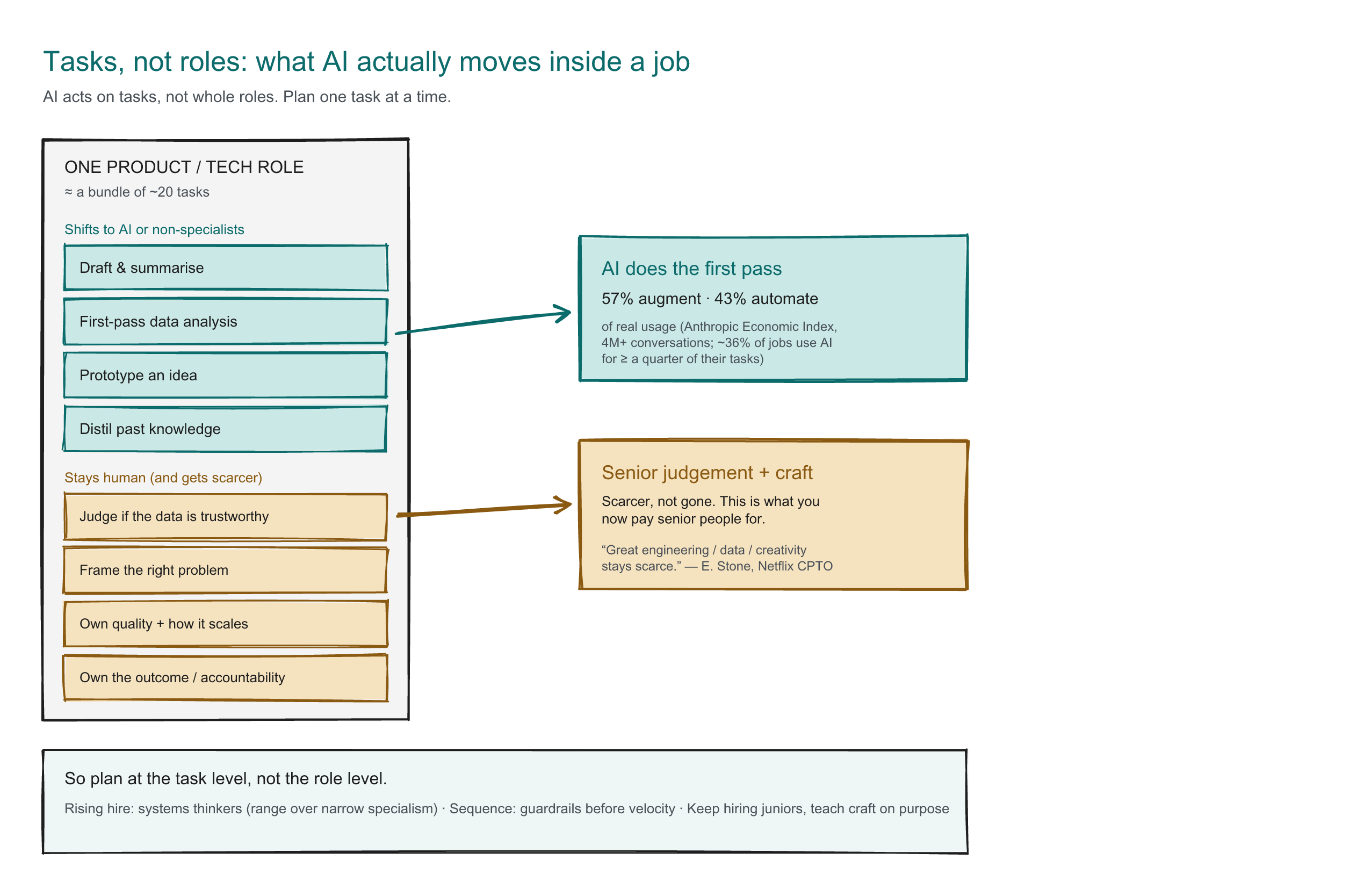 Figure: what moves and what stays inside one product or tech role. Drafting, summarising and first-pass analysis shift to the machine or to a non-specialist; judgement, framing and accountability stay human, and get scarcer.
This is also why “will AI replace this role” keeps misfiring as a planning question. Ask it of a role and you get a shrug. Ask it of the twenty-odd tasks that actually make up that role and you get a real answer, one task at a time, which is the altitude a leadership team can act on.
Where this goes next: whole workflows, not single tasks
Everything above is a snapshot, and it is worth saying plainly that the snapshot is already moving.
The task-level view holds because that is how the work is being taken today: a slice here, a slice there, inside a job that still belongs to a person. But the slices are getting longer. On OpenAI’s own usage data for its coding agent, the share of users handing over at least one task estimated to need more than eight hours of experienced human work rose roughly tenfold in the first half of 2026. That is not a new task being automated. That is a sequence being handed over.
You can see the same shape in my own work. A year ago the useful unit was “research this and draft it.” Now the unit is closer to the whole chain: watch the sources, sort what matters, research it, draft it, review it against a written standard, prepare it for search, publish it, watch how it performs, and let what you learn shape the next one. Each of those was a task. Together they are a workflow, and increasingly the workflow is what gets handed over, not the steps inside it.
When that happens, the human does not disappear from the work. The human moves up it. You stop tuning the headline and start deciding which campaign is worth running this quarter — what the standard is, which bets to place, what “good” means here, and when to stop. There is now a name for this in the research: a Microsoft Research study of 319 knowledge workers, published at CHI in 2025, describes the shift as moving from task execution to task stewardship — guiding and monitoring rather than producing. Note who published it, and note that it cuts against their commercial interest, which is a reason to take it more seriously rather than less.
That is the direction, and I think it is the right thing to plan for. Three things are worth holding onto while you do.
It is not yet how most people work. The same OpenAI data that shows the tenfold rise also shows that in a sample week, about two-thirds of paying organisational users ran no concurrent agents at all. The orchestration future is real and it is arriving unevenly. If your teams are not there yet, they are not behind — they are normal.
Moving up is a choice, not a promotion that happens to you. A Harvard Business School study of 244 consultants found the people working with AI split three ways. Most collaborated with it. A small group used it to deepen their own expertise. And roughly a quarter simply handed the work over, with nearly half of that group accepting the output without changing a word. The authors were struck by it, because these were skilled, conscientious professionals who knew their work would be reviewed. Stewardship is the good outcome. Abdication is the easy one, and it looks identical on a Tuesday afternoon.
The judgement gets harder, not easier. The uncomfortable finding is that oversight degrades exactly where you would want to lean on it. In a controlled study of nearly 2,800 people checking AI-extracted figures, making participants do the correction work themselves increased how often they accepted wrong answers. Paying them more did not fix it. If your plan is that a person will catch what the machine gets wrong, that person needs time, a written standard, and a small enough volume that checking stays real work rather than a formality.
None of that argues against the direction. It argues for being deliberate about it. The companies that will get the most out of the next two years are the ones who decide, on purpose, which judgements stay with a person — and then protect the conditions that let that person actually exercise them.
What it means for a company your size
Netflix has thousands of engineers and can afford to reorganise around all this. You probably cannot, and you do not need to. The moves that transfer are smaller and more useful than the headlines suggest.
Hire for range, not narrowness. The profile Stone says she needs more of is the systems thinker: someone who can look across business domains and see the building blocks, rather than the deep specialist who knows one narrow thing extremely well. She is blunt about the other side of that: the days of very narrow, deep specialisation look more limited to her now. For a mid-sized company that is good news, because you were never going to staff ten specialists anyway. The person who already moves across marketing, operations and a bit of data is now more valuable, and AI extends their reach further. Systems thinking even has a teachable version: for any problem, “step out one click” and ask what you are assuming about the larger space before you solve the small one.
Put the guardrails in first. The unglamorous half of Stone’s answer is infrastructure: a clear source of truth for data, a habit of reviewing AI output before it ships, and an explicit line that a named human owns the outcome. This is the same governance layer the economists’ letter pointed at, translated to company scale. In a regulated firm I work with, the first genuinely useful step was not a new tool at all. It was deciding, in writing, which tasks AI is allowed to touch without review and which it is not, and naming who signs off when it does. That one document did more for adoption there than any pilot had, because it let people move quickly on the safe tasks without wondering whether they were about to cause a problem.
Keep hiring juniors, and change how you train them. This is where the labour data gets pointed. The aggregate employment numbers have not broken yet, but a Stanford payroll study, “Canaries in the Coal Mine?”, found roughly a 13% relative decline in employment for 22-to-25-year-olds in the most AI-exposed occupations since generative AI arrived. Read “relative” precisely: it is a decline measured against comparable workers elsewhere — not thirteen percent of young people out of work.
Stone’s response is not to stop hiring early-career people; she still runs intern and new-grad programmes and calls them central to the strategy. It is to invest more in mentorship, because the craft that juniors used to absorb by doing the grunt work now has to be taught deliberately. The quiet trap for a company your size is to freeze junior hiring for a year or two to save cost, and hollow out your own supply of senior people a few years later.
The honest caveat, and what still transfers
It would be a mistake to lift a Netflix playbook straight into a 200-person company. Stone runs a team with thousands of engineers, decades of accumulated experiments, and a culture built on what Netflix calls talent density: the deliberate luxury of hiring only exceptional people and paying top of market. You have a leaner team, less slack, and no ability to run twenty parallel bets and quietly kill nineteen. Some of her answers are only available at her scale.
So separate what transfers from what does not. What transfers is the thinking: read change at the level of tasks rather than roles; sequence guardrails before speed; hire for range; teach craft on purpose now that it is no longer absorbed by osmosis. What does not transfer is the scale itself: the parallel bets, and the option to buy your way to talent density.
And hold onto the honest version of the timeline, because it cuts against both the panic and the complacency. The letter’s core worry is credible: the adjustment window looks shorter than in past technology shifts, and preparing after the fact is the expensive option. That is a forecast, though, not a measurement.
“Act now” is not the same as “cut now.” The evidence in hand does not show AI erasing jobs across the board. It shows the task mix inside jobs moving, plus one sharp point of pressure at the entry level. The response that fits both the urgency and the data is to reshape tasks and invest in your people, not to restructure your headcount around a forecast.
The alarm and the manual turn out to say the same thing at two altitudes: prepare now, and the preparation is boring.
So do the boring version this quarter. Take one role on your team, write down the tasks inside it, and mark the three that could reasonably move to a machine or to a non-specialist, and the three that must not move at all. Then name, in writing, who reviews the first three. One role, one afternoon: that is where this actually starts.
Sources: Lee et al., “The Impact of Generative AI on Critical Thinking” (CHI ‘25) · Johnston et al., “The Shift to Agentic AI: Evidence from Codex” · Randazzo et al., HBS Working Paper 26-036 · Beck et al., “Bias in the Loop” · Stanford Digital Economy Lab: “We Must Act Now” · “We Must Act Now”, full statement · Lenny’s Podcast: Netflix CPTO Elizabeth Stone on AI and the future of product and tech roles · Anthropic Economic Index: Handa et al., “Which Economic Tasks Are Performed with AI?” · Stanford Digital Economy Lab: “Canaries in the Coal Mine?”
This piece is part of the AI Leadership Journal. It is written by Claudius Gramse. evonomics is the independent AI consultancy helping mid-sized European companies embed AI into the processes that actually run their business. If you want to talk through what this looks like for your own team, that is the work I do.